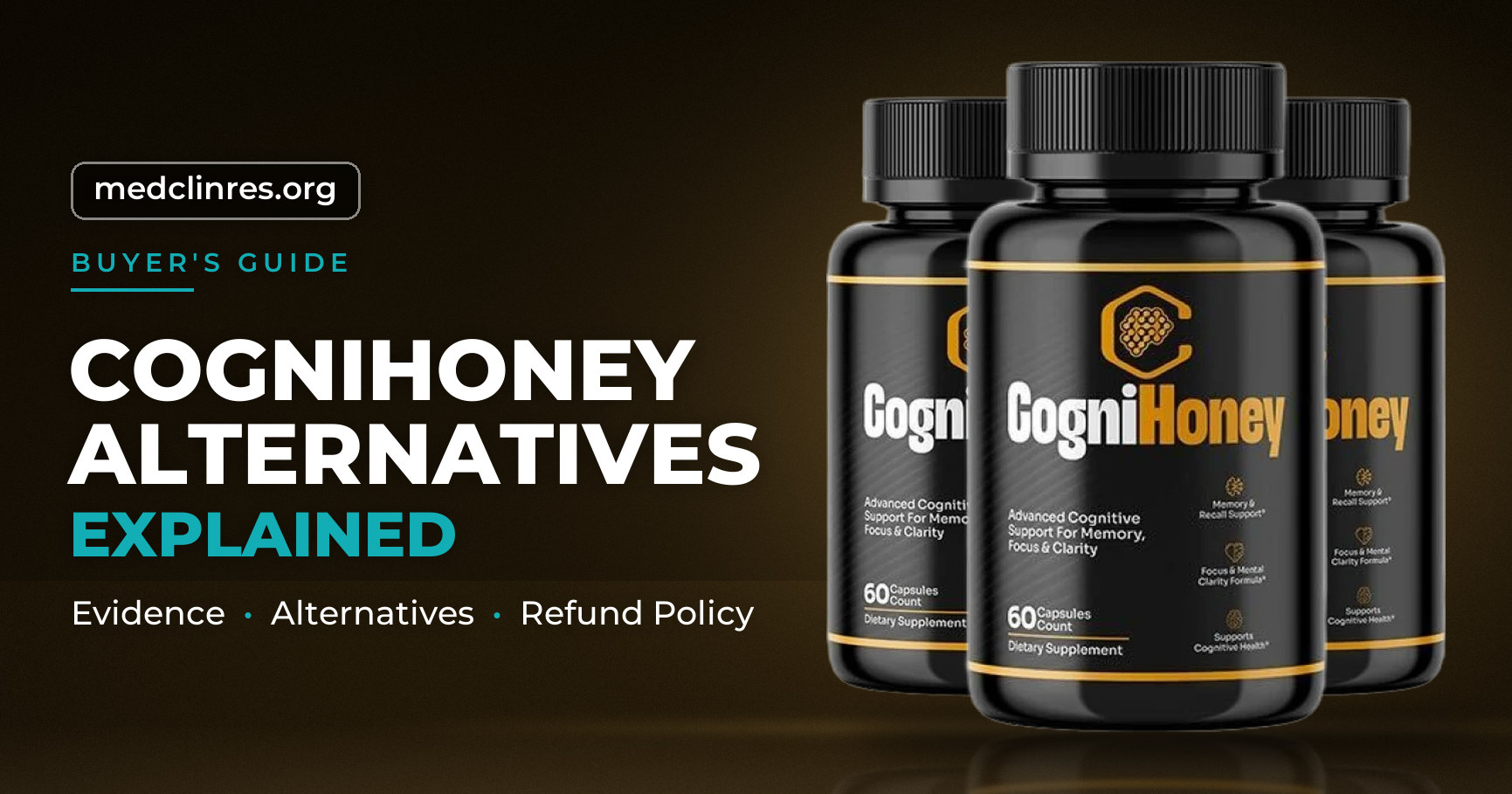
If you are searching for CogniHoney alternatives (also searched as cogni honey alternatives), you probably want to know what else can help your memory and focus before you spend money on a powder. The research points first to sleep, regular movement, a balanced diet, mental challenge and stress management, which both Harvard Health and Cleveland Clinic put at the centre of memory care. Below you will find what each option’s studies found, what the seller says about CogniHoney, and what to check before you order.
Disclosure: A number of the links on this page are affiliate links. When you purchase through them, this publication may be paid a commission. Your price is the same either way.
How do I fix my poor memory?
Start with the habits the guides keep returning to. Harvard Health’s memory guide says proven ways to help protect memory include a healthy diet, regular exercise, not smoking, and keeping blood pressure, cholesterol and blood sugar in check. It also suggests aiming for seven to nine hours of sleep each night.
Cleveland Clinic’s memory tips add that sleep is essential for forming and retrieving memories, and that chronic stress can harm your brain. Stanford’s working memory strategies, written for students, suggest reducing the load on your memory with phone reminders and automated email rules, and breaking information into smaller chunks. Harvard also suggests repeating a person’s name as soon as you are introduced and paraphrasing parts of a conversation to reinforce it.
For a step-by-step version of these habits, read our guide on how to improve memory and focus.
How do I fix brain fog and lack of focus?
Harvard Health’s focus tips start with listening closely and asking someone to repeat what they said, then paraphrasing to confirm you understood. They also suggest meeting in quieter places, doing one thing at a time, and letting voicemail take the call while you finish a task.
Stanford’s guide notes that cognitive fatigue impairs working memory, so short breaks while you study and throughout the day can help retention. Healthline’s memory guide says mindfulness is associated with reduced interference in working memory, which it describes as older information getting in the way of learning newer information.
Brain fog also has causes that are not about focus habits. Harvard’s memory guide says stress, fatigue, sleep deprivation and feeling overwhelmed can contribute to short-term forgetfulness. It also says temporary mild cognitive impairment can be brought on by sleep apnea, depression or medications, so review your prescriptions with your doctor if you suspect a medicine is involved.
What are the signs of memory loss?
Harvard’s memory guide separates normal forgetting from something to check. Normal forgetting is small, like not remembering where you left your car keys. The concern starts when you have difficulty completing familiar tasks, or when forgetfulness goes beyond minor inconvenience and disrupts your day-to-day functioning.
| Sign | What it can look like, according to the guides |
|---|---|
| Trouble completing familiar tasks | Harvard’s memory guide names this as the point to pay attention to. |
| Forgetting important things | Forgetting what was discussed in last week’s Zoom meeting, which Harvard gives as an example of amnestic mild cognitive impairment. |
| Missing bills | Forgetting to pay bills, listed in Cleveland Clinic’s guide. |
| Getting lost | Getting lost in familiar places, listed in Cleveland Clinic’s guide. |
| Trouble following conversations or making decisions | Difficulty keeping up with a conversation or making decisions, which Harvard describes as non-amnestic mild cognitive impairment. |
If these signs are showing up and getting in the way of daily life, Cleveland Clinic says it is time to talk with a healthcare provider.
Which vitamin is best for memory and focus?
No single vitamin is ranked best for memory and focus. Harvard’s memory guide says you do need certain vitamins for memory, but studies have not shown that taking more than the recommended daily allowance (RDA) has a beneficial effect. It points to B vitamins and vitamin D as the ones that merit special attention. A blood test can show whether you are low in vitamin B12, and you can get plenty of vitamin D through 10 to 15 minutes of sun exposure daily, with a supplement if that is not possible.
Omega-3 fatty acids come up often too. Healthline’s memory guide says that if you do not enjoy fatty fish, a supplement can help you reach your daily intake.
Is there a #1 brain supplement?
No product is ranked number one for brain health in these guides. Harvard’s memory guide says marketers frequently make unproven claims about memory supplements. Its example is ginkgo biloba, often touted as a wonder supplement for mental function, although numerous studies have found it has no effect on memory, attention or risk of dementia. When a product calls itself the top brain supplement, ask which studies test its specific ingredients.
Which two supplements should never be taken together?
The clearest combination warning in Harvard’s memory guide is about medicines, not supplements. It advises reviewing your prescriptions with your doctor, because many medicines can cause brain fog and forgetfulness. It singles out drugs with anticholinergic properties, including older antihistamines such as diphenhydramine (Benadryl). Before you combine any supplements, ask a pharmacist to check your full list, including medicines.
How do the usual alternatives compare?
Most of the options below are habits or foods rather than purchases. The studies behind them are described in the guides named in each row.
| Option | What the research found | What it takes |
|---|---|---|
| Sleep | Harvard’s memory guide suggests seven to nine hours a night. Cleveland Clinic calls sleep essential for memory. | A consistent sleep routine. No purchase. |
| Exercise | Harvard’s memory guide says physical activity has been associated with a decreased risk of memory loss over time. Healthline says exercise can improve cognition in older adults with mild cognitive impairment. | Movement you will keep up. Harvard gives walking, swimming and tennis as examples. |
| MIND diet | Harvard’s memory guide says that in one study, MIND diet adherents were 30% to 35% less likely to score poorly on cognitive tests. | Leafy greens, nuts, berries, fish and poultry, while avoiding red meat, butter, cheese and sweets. |
| Omega-3 | Healthline notes omega-3 fatty acids are thought to play an important role in brain health. | Fatty fish, or a supplement if you do not eat fish. |
| Brain games | Healthline cites a 2022 review finding that serious games may improve verbal, nonverbal and working memory in older adults with mild cognitive impairment. It notes the review did not include a large number of studies. | Puzzles, crosswords or games. Cleveland Clinic says there is good evidence that engaging games can help keep the brain active. |
| Mindfulness | Healthline says mindfulness is associated with reduced interference in working memory and improved verbal learning and memory. | Paying attention to the present and gently refocusing when your mind wanders. |
| Handwritten notes | In science-backed memory tips, researchers are reported to have found that writing information by hand is more effective than typing it for learning concepts. | A pen and paper for key points. |
| Reminders and chunking | Stanford’s guide recommends reminders, automations and chunking to reduce the mental load on working memory. | Setting up phone reminders and grouping information into smaller parts. |
| Ginkgo biloba | Harvard’s memory guide says numerous studies found no effect on memory, attention or risk of dementia. | A supplement purchase, with no benefit found in those studies. |
What does CogniHoney claim, and how do its terms compare?
The seller says CogniHoney is a powder with four listed ingredients: baobab fiber, L-arabinose, spermidine and konjac glucomannan. Its sales page lists “Clinically Tested” among its features and says that clinical research shows the cognitive benefits of its key ingredients compound after 90 days of consistent use. Ask the seller for the study behind those claims before you order.
The seller says CogniHoney is made in an FDA-registered facility. The seller’s own disclaimer says its statements have not been evaluated by the Food and Drug Administration and that the product is not intended to diagnose, treat, cure or prevent any disease.
The sales page reports 17,126 customers and a 4.98 out of 5 rating from more than 2,000 reviews. Read the testimonials with care: one of them, from Sarah P., names “Neo Vital” rather than CogniHoney.
How do CogniHoney’s refund terms work?
The homepage and the return policy say different things, so read both. The table below lists the seller’s stated terms.
| Term | What the seller says |
|---|---|
| Guarantee length | 60 days from purchase |
| Refund wording | A 100% money-back guarantee and a full refund “no questions asked” (homepage) |
| Minimum use | A 30-day minimum usage period; requests made before then will not be accepted (return policy) |
| Restocking fee | 15% deducted from the total order amount (return policy) |
| Shipping fees | Non-refundable (return policy) |
| Return shipping | Paid by the customer (return policy) |
| Bottles to return | All bottles, including empty ones (homepage); only sealed products are refunded (return policy) |
| Processing time | The return process may take up to 30 days (return policy) |
| Fulfilled orders | Cannot be cancelled or refunded unless the denial upon arrival is confirmed (return policy) |
| Chargebacks | If a chargeback dispute is in progress, the seller will no longer process a refund (return policy) |
| Billing | All options are one-time charges (homepage) |
| Shipping time | Processed in 2 to 3 business days; US average 5 to 7 days; international 10 to 12 days (sales page FAQ) |
| Bundles | The seller says every 6-bottle order gets free shipping, and that 96% of customers order 6 bottles, which it calls the recommended option |
| Contact | contact@getCogniHoney.com or +1 (323) 237-8559 (return policy); the guarantee section gives contact@customercs.com |
In practice, the 30-day minimum use rule and the 15% restocking fee mean the refund is narrower than the homepage’s “no questions asked” wording. For ingredients, price and refund terms in one place, read our guide on is cognihoney a scam or legit. Prices and bundle prices change, so check today’s price directly on the order page.
Could I just do this myself instead?
You can build these habits yourself, and the guides above show what to aim for. The difference is effort. A walk most days, a regular bedtime, meals built around fish, leafy greens and nuts, and reminders on your phone all take daily attention. A powder is easier to remember than a lifestyle change, and the seller’s testimonials mention an easy one-scoop routine. Choose the path you will actually keep up.
Before you order
- Ask the seller for the study behind “clinically tested” and the 90-day claim.
- Confirm which refund rule applies: the 30-day minimum use period, the 15% restocking fee, or the “no questions asked” wording.
- Confirm the contact address, since the return policy and the guarantee section list different emails.
- Check the label for ingredient amounts per scoop and the number of servings in the bottle.
- Check today’s price and bundle prices on the order page.
- Ask a pharmacist to check your medicines and any supplements together before you combine them.
If you decide to look at CogniHoney, start at its Product Page, then check the label and today’s price before you buy.
By the Clinical Research Explained Editorial Team
This article is for general information purposes only and does not constitute medical advice. Consult your doctor or qualified healthcare provider before making changes to your health routine.